L&L Movers and L&L Car Service business cards
Motherless BrooklynThe L&L Movers and L&L Car Service business cards are small but consequential markers of the changing organization Frank Minna built around four boys from St. Vincent’s Home for Boys. First they named a moving company and helped turn the boys into its junior staff; years later, a revised card presented L&L as a 24-hour car service, the cover for a detective agency. The cards made an improvised crew legible to clients and gave its members a name and a way to be contacted, while the difference between their printed business and their actual work widened into one of the story’s central disguises.
The first cards and the boys’ recruitment
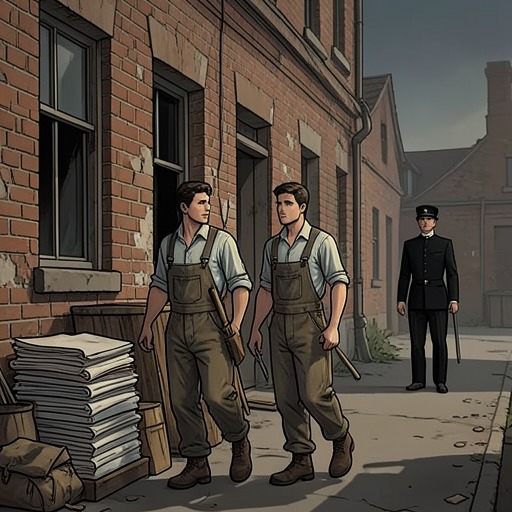
On the boys’ first day with Frank Minna, the promise of work arrived as cash and print. After giving each boy twenty dollars, Frank Minna handed each one a white card for L&L Movers. It bore the slogans NO JOB TOO SMALL and SOME JOBS TOO LARGE, listed Gerard Minna and Frank Minna, and included a telephone number. The boys had been brought away from the Home without an explanation; the cards supplied a first, concrete account of what their new place in the outside world might be. When Tony Vermonte asked which of the two names belonged to Frank Minna, Frank Minna identified himself, then stressed that the boys were a moving company doing moving work.
The exchange established more than a label for the van. The carefully repeated description of the work as moving gave the boys an official answer to what they were doing, even as the jobs they would perform soon showed that the business was not limited to ordinary household moves. The cards, together with the eighty dollars distributed among the four boys, formally installed Lionel Essrog, Tony Vermonte, Gilbert Coney, and Danny Fantl as L&L Movers’ junior staff. Their small printed format suited an organization that was still being improvised: a business name, two partners, a phone number, and a promise broad enough to cover jobs of very different kinds.
From contact details to a working identity
The first cards belonged to a practical routine of uncertain hours and varied assignments. Frank Minna summoned the boys sporadically, sometimes with a day’s notice and sometimes without warning; the possibility of being called back drew them to wait after classes for the familiar sound of his van. They carried merchandise through storefront basement grates, moved furniture in brownstone walk-ups, helped clear a fire-damaged factory, assembled and dismantled temporary stages for the Atlantic Antic, and emptied an electronics showroom. The card’s assurance that no job was too small or too large echoed this range, though it did not disclose the obscurity or unease surrounding some assignments.
As they worked, the boys learned to stand together before clients who watched them for signs of theft or disloyalty. They took nothing and revealed nothing, but they watched in return and gathered information. Their work made them more than a collection of hired hands: the boys developed a collective identity at the Home and at Sarah J. Hale High School, smoothing earlier antipathies and defending one another. The original cards therefore belong to the formation of the Minna Men as well as to the business that employed them. Their printed designation gave an outward shape to a group whose shared membership was taking form through repeated summonses, jobs, and mutual protection.
The revised card and the agency’s cover
After Frank Minna returned from a two-year absence, he brought a changed card into the boys’ lives. The new card read L&L CAR SERVICE, promised TWENTY-FOUR HOURS, and gave a telephone number; unlike the earlier version, it had no slogan and listed no names. Frank Minna handed the boys twenty dollars apiece again and asked whether they had learners’ permits. He took them to see the boarded Bergen Street storefront that would become L&L Car Service and arranged free driving lessons. The boys were to obtain licenses and help rehabilitate the office, which would be equipped with radios, telephones, tape recorders, microphones, and other apparatus.
The card’s plain service-company wording concealed the larger purpose Frank Minna eventually disclosed: L&L Car Service was not really a car service but a front for a detective agency. That gap between printed identity and actual function was not merely a twist in the name. The round-the-clock service language presented a plausible public business, while the office and the boys’ training prepared them to work with cameras, recording equipment, and surveillance. The revised card thus marked a change in L&L’s operations without announcing it openly. Where the first card had defined the boys as movers, the second offered the public a cover for their emergence as investigators.
The change also altered what the omission of names could mean. The first card explicitly joined Gerard Minna and Frank Minna in print; the later card identified the business without naming either man. The narrative does not state that this omission was intended to signal a particular secret, but it creates a pointed contrast between the two versions: a named partnership on the moving card, then a service identity stripped down to its title and telephone contact as the enterprise became a detective agency.
Cards, records, and the work of investigation
In the later L&L office, the business identity had become part of a larger apparatus. A laminated map of Brooklyn displayed the prices of rides to different neighborhoods, while telephones, file cabinets, and a computer stood behind the Formica counter. The room also contained Frank Minna’s cigarette butts, his telephone log, and a bitten sandwich: traces of the absent man among the tools of the business. Against that setting, cards were one element in a system of contact and information, but a portable one, capable of carrying L&L’s name beyond the office.
After Frank Minna’s death, Lionel Essrog returned to the office with Frank Minna’s wallet. He removed the bundle of Frank Minna’s business cards and slipped them into his pocket before setting the wallet on the counter. Nearby, he marked WOMAN, GLASSES, and ULLMAN, DOWNTOWN in a notebook as new leads in the investigation. The scene places the cards beside the fragile records and clues through which the Minna Men try to reconstruct what happened. They remain evidence of a working identity, but now that identity must be used by the men left behind rather than directed by Frank Minna.
The cards also surface in the question of how others located L&L. Tony Vermonte suggested that Frank Minna’s dying words naming L&L, a business card in his coat, or Gilbert Coney’s disclosure of names might explain how they had been found. His remark does not establish which clue gave the office away; it shows instead that a card could connect a person to the organization in ways its members could not fully control. A device designed to make a business reachable could also expose its people.
The meaning of the two versions
The two cards chart a progression from labor to surveillance and from an announced partnership to a less specific institutional face. The moving-company card accompanied paid work that mixed ordinary household jobs with obscure errands for powerful clients. The car-service card accompanied driver training and the preparation of a storefront that would serve as a detective agency. Neither card itself explains the interests behind every assignment: work for The Clients could make the Minna Men agents within stories whose beginnings and endings they could not see, while Frank Minna’s operation also put them in the path of Matricardi and Rockaforte’s larger business interests.
Their importance lies in how modestly they perform this transformation. A card does not reveal the full organization behind its name; it gives the bearer a usable public description, a phone number, and a place in a network. For the boys, the first cards helped make recruitment feel like employment and fellowship. The second made detective work look like transportation service. And after Frank Minna was gone, the remaining cards turned from instruments of his business into objects Lionel Essrog could carry as he and the others tried to understand the enterprise he had left them.